The seamless, horizonless background, where the floor curves up into the wall with no visible corner, is the look behind most clean product shots, dance films, and automotive spots. There are two ways to get it: build a permanent cyclorama wall, or hang a tensioned fabric cyc or printed backdrop. They solve the same problem and produce a similar image on camera, but they differ sharply on cost, space, and how much you can change your mind later. Here is how to decide which one belongs in your studio.
What each one actually is
A hard cyclorama, often called an infinity cove, is construction. A typical build uses steel studs framing a wall and floor, with flexible drywall bent to form a curved transition, then a skim coat to make the join disappear. The curve, or coving, usually runs a 2-to-4-foot radius so the camera reads a smooth horizon rather than a hard edge. Once it is painted flat matte white, it becomes a fixed part of the room. A fabric cyc takes the opposite approach: a large panel of seamless fabric, either a plain sweep or a custom-printed backdrop, is hung from a pipe or track and tensioned so it hangs flat, sweeping down to the floor to imply the same infinite background. One is a renovation; the other is a rig you can strike in an afternoon.
Cost and permanence
The money gap is wide and it tracks permanence. A built-in drywall cyc commonly runs in the range of $5,000 to $20,000 or more, driven by size and local labor. Pre-fabricated cyc panels that bolt together land lower, roughly $3,000 to $10,000, and a do-it-yourself curved base can be done for $500 to $2,000 if you are handy. A seamless paper roll, by contrast, is a $50-to-$80 consumable you tear off and replace. A tensioned printed fabric cyc sits between those extremes: far below a construction budget, reusable rather than disposable, and portable if you move studios.
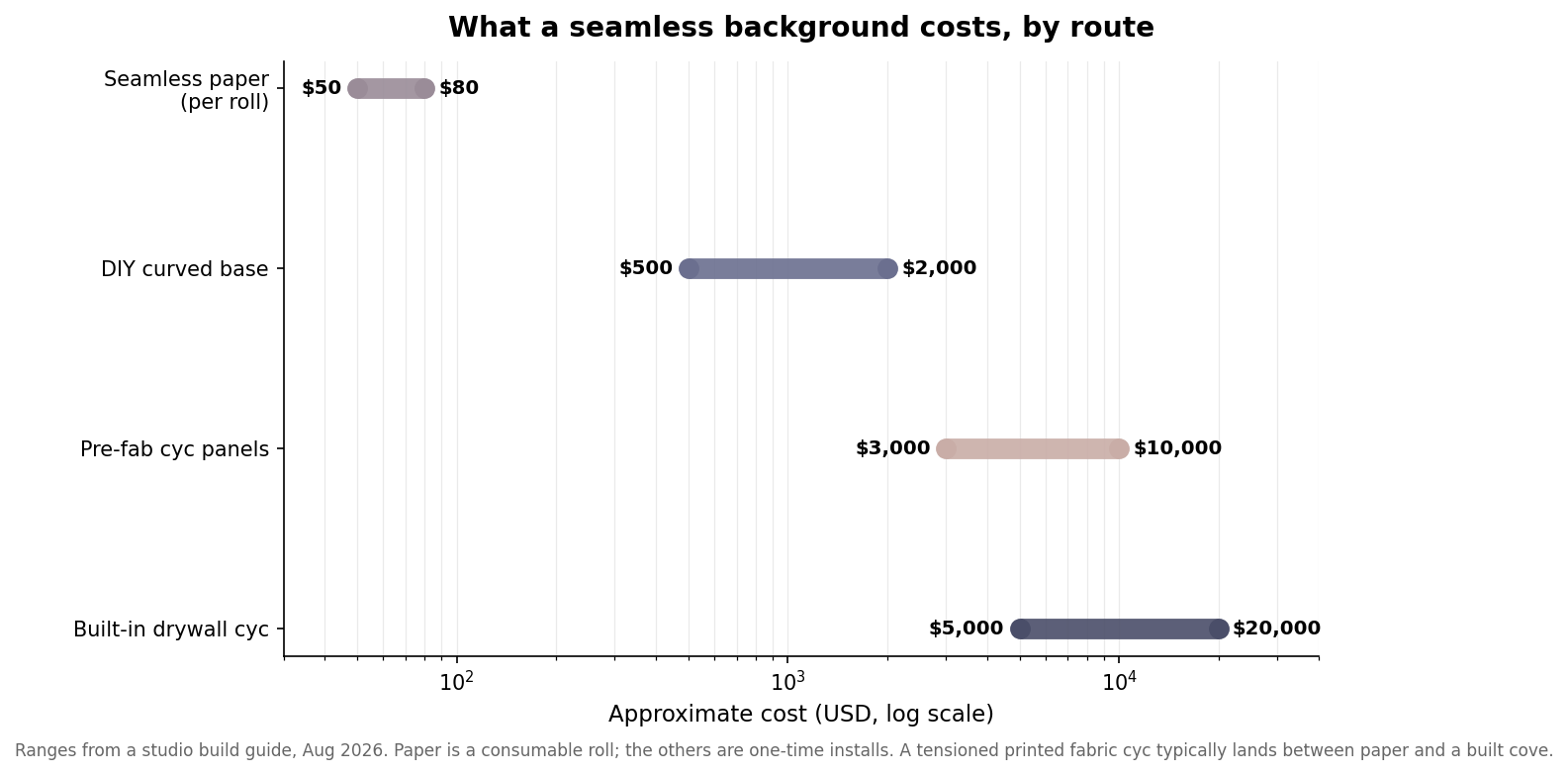
Permanence cuts both ways. A hard cove delivers the most convincing seamless surface and never needs re-hanging, but it is stuck in one room, it eats that floor space full time, and it demands upkeep: under heavy use, operators report touching up scuffs weekly and repainting the whole surface as often as monthly. A fabric cyc gives that space back the moment you strike it, and a damaged or dated backdrop is swapped rather than re-skimmed.
Space, ceiling, and seams
Both approaches are hungry for room. A working cyc that is 16 feet wide with about 12 feet of depth occupies roughly 200 square feet of floor, and a genuinely functional cyc studio usually wants 600 to 1,500 square feet once you add lighting and camera distance. Ceiling height matters just as much: 10 to 14 feet covers most photography, while film and commercial work often calls for 16 to 20 feet or more so lights and grip clear the frame.
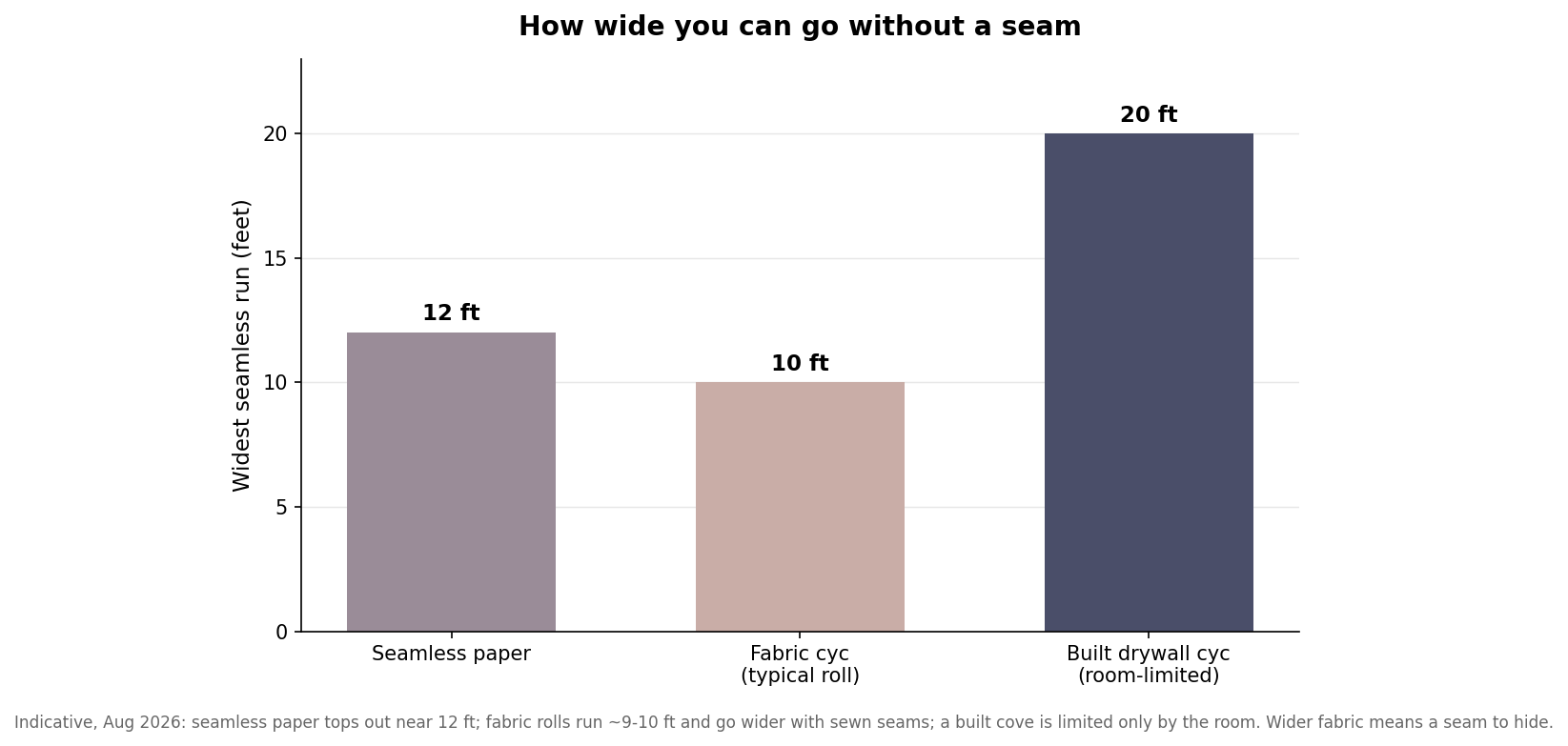
Seams are the deciding technical detail for fabric. Seamless paper tops out around 12 feet wide, and a single fabric panel commonly runs about 9 to 10 feet before you need a sewn seam; go wider and there is a join to light around or retouch out. A built cove has no seam at all and is limited only by the room, which is exactly why large productions still pay for construction. For most studios, though, a fabric width in the 9-to-16-foot range covers the shot, and a well-placed seam behind the subject disappears on camera.
White, green, or printed: the surface question
Whichever structure you choose, the surface color drives what you can do with it. A white cyc is the neutral canvas: lit evenly and pushed one to two stops brighter than your key, it blows out to clean white, and lit down it reads as soft gray, so the same surface serves high-key product work and moody portraits. A green screen is a different tool entirely. It exists to be removed in post, relying on the fact that camera sensors are very sensitive to green while skin tones contain none, which makes for a clean key, as long as nobody in frame wears green. Green demands even, spill-controlled lighting to key well, and it is only worth it when you are compositing.
This is where a fabric cyc has a quiet advantage: the surface is a choice per shoot. A printed backdrop can be a branded environment, a textured scene, or a specific color, and you can own several and hang whichever the job needs. A painted hard cove is one color until you repaint it. If your work is mostly clean white or chroma key, the hard cove is a strong, permanent answer. If it varies week to week, swappable printed fabric keeps you flexible.
Which to choose
Choose a hard cyclorama wall when the studio is permanent, the ceiling and floor space are yours to commit, and you shoot the seamless look often enough to justify five figures and ongoing paint upkeep, especially for large or high-end film work where no seam can show. Choose a fabric or printed cyc when you need flexibility, share or rent the space, want more than one background, or simply are not ready to renovate. Many studios run both: a modest painted cove for everyday white and green work, and a library of printed fabric backdrops for everything a single painted wall cannot be. Match the structure to how often you shoot the look and how much the room is truly yours.