A seam across a stage scrim is the kind of detail nobody notices until a light rakes across it and the whole audience does. On a translucent scrim especially, a horizontal seam catches light differently from the fabric around it and can wreck a clean reveal. The good news is that theatrical fabric is made specifically to avoid that problem, and if you specify your order correctly you can hang a very tall scrim with no horizontal seam at all. Here is how the fabric widths work, when a seam becomes unavoidable, and how to keep one from showing.
Why stage fabric comes in extra-wide goods
Ordinary drapery and upholstery fabric comes off the bolt around 54 inches wide, which is useless for a backdrop that has to cover a proscenium. So scenic mills weave wide goods: sharkstooth scrim and muslin are produced in bolts that run many times wider than normal cloth. Rose Brand’s 8/2 sharkstooth, a 100% cotton open-weave net weighing about 2.74 ounces per square yard, is available in widths up to 39 feet, and extra-wide muslin reaches about 40 feet. That single dimension is the key to a seamless drop.
The reason it matters is a technique called railroading. Because the fabric is so wide, it is turned on its side and hung so that the width of the bolt becomes the height of the drop. The length you order off the roll then becomes the width of the finished scrim, and that length is effectively unlimited. So one continuous piece of 39-foot goods yields a drop up to 39 feet tall and as wide as you like, with no seam anywhere in the field.
How railroading removes the horizontal seam
Put plainly, a horizontal seam only appears when your drop is taller than the widest goods available. If your scrim needs to be 30 feet tall, it fits inside 39-foot sharkstooth with room to spare, and it can be built from a single width with a clean, unbroken face. If it needs to be 45 feet tall, you are past the goods width and a seam has to go in somewhere. The whole planning exercise, then, is comparing your required drop height against the seamless width of the material you want.
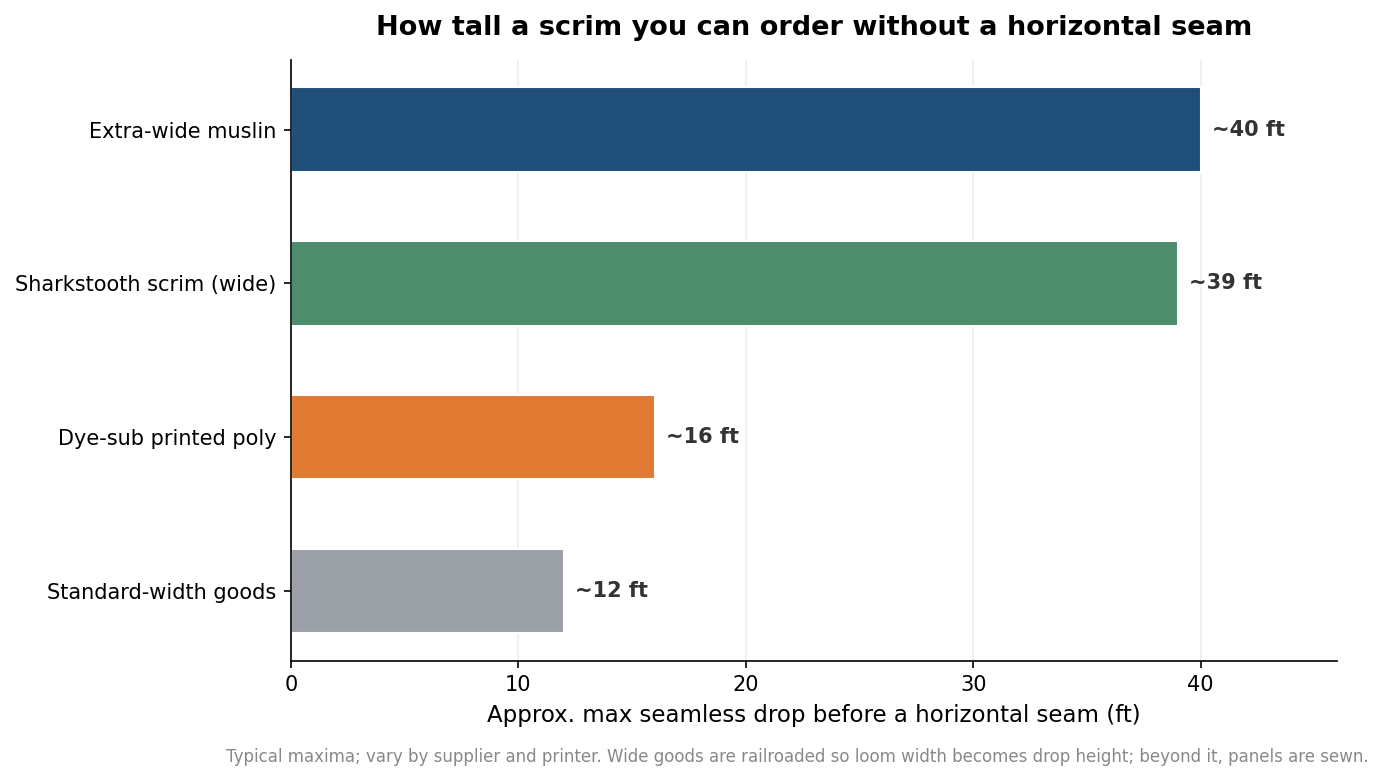
This is also where material choice bites. Printed backdrops made on dye-sublimation poly are limited by the printer, and grand-format textile printers commonly top out around 10 to 16 feet of print width per pass, so a tall printed poly backdrop is assembled from tiled panels with seams between them. Printable sharkstooth, by contrast, can be printed on the same wide goods used for plain scrim, which is why a large printed scrim on cotton can stay seamless where the same image on poly would be paneled. If a seamless printed face matters to your show, the fabric you print on decides whether you get one.
Seamless height, and why color can limit it
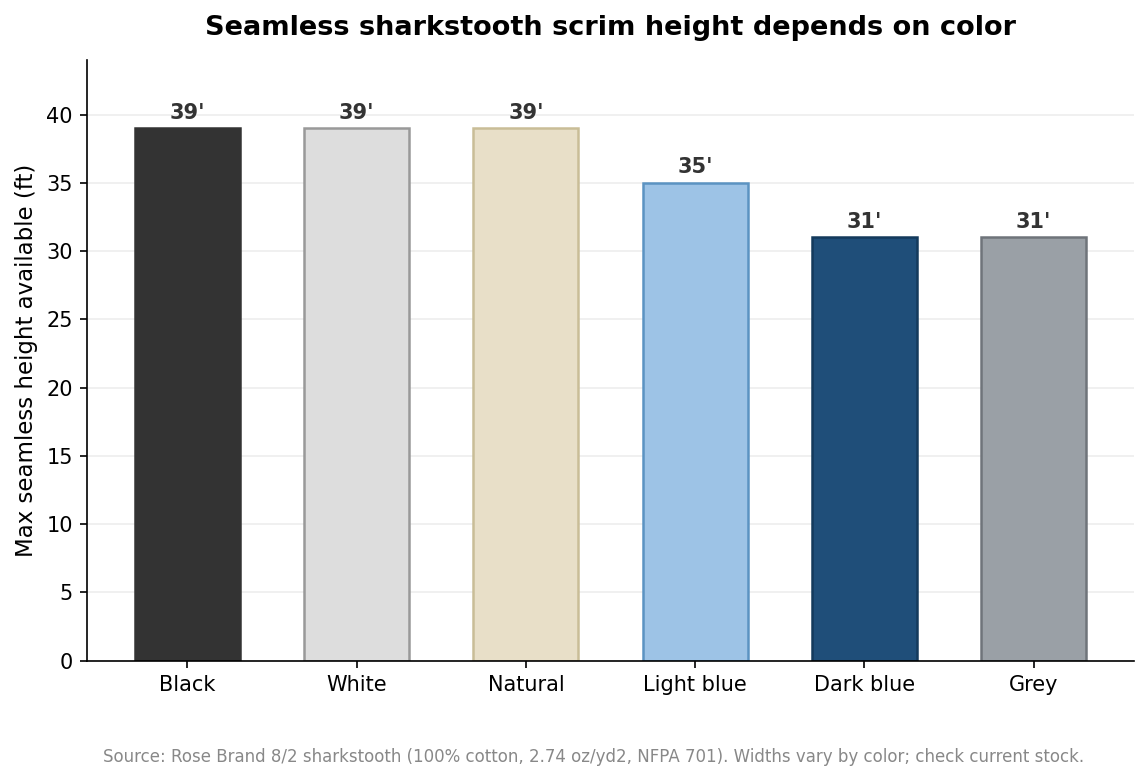
There is a catch that surprises people: the maximum seamless width is not the same for every color of the same fabric. With Rose Brand sharkstooth, black, white, and natural are woven all the way out to 39 feet, but light blue tops out around 35 feet, and dark blue and grey are made only to about 31 feet. If your design calls for a 34-foot grey scrim, the color you picked, not the fabric type, is what forces a seam. Confirm the seamless width in the exact color you want before you commit the height, because the spec sheet ranges vary shade by shade and stock changes over time.
Two practical habits save trouble here. First, give your supplier the finished drop height early and ask them to confirm it fits their current goods width in your chosen color, rather than assuming the largest number on the page applies to every shade. Second, remember that the drop needs a little extra fabric beyond the visible height for the top finish and the bottom pocket, so a drop that uses nearly the full goods width leaves no margin for hems. Building in headroom keeps you inside the seamless window.
When a seam is unavoidable, and how to hide it
Sometimes the drop genuinely exceeds the goods width, and then the craft is in placement, not avoidance. A well-built horizontal seam is sewn flat with a generous overlap and, on opaque muslin, it largely disappears under even lighting. On a translucent sharkstooth used for a lit reveal, a seam is far harder to hide, so the move is to position it where it will not read: aligned with a masking border, a set piece, or a scenic horizon line, or kept above or below the zone the audience actually watches during the effect. If the scrim is being flown as part of a larger soft-goods package, planning the seam to sit behind a border or teaser hides it in plain sight.
For printed work that has to be tiled, treat the seams as part of the design. Break the image along natural vertical edges, at a color change or an architectural line, so the panel joins fall where the eye expects an edge rather than through an open sky or a face. A good print vendor will map the tiling to the artwork instead of splitting it on a blind grid.
Specifying a seamless scrim order
Start from the finished drop height and width, then add allowance for the top and bottom finishing. Choose your fabric and color, and confirm that the seamless goods width in that specific color exceeds your drop height with margin to spare. If it does, you can order a single seamless piece; if it does not, decide early where a horizontal seam can live and tell your supplier so it is engineered, not improvised. For printed scrims, ask whether the image will be printed on wide sharkstooth as one seamless face or tiled on poly, because that answer changes both the look and the price. Nail those questions down before artwork and cut, and the scrim that arrives will hang the way it did in your head, without a line across it that only the lights can find.