Custom stage scrims sit somewhere between a banner and a piece of stage machinery. Print a logo or design on the fabric, light it from the front, and it reads as an opaque backdrop; light it from behind, and it turns nearly transparent, letting a band walk through a glowing reveal. That dual behavior — plus the fact that scrim ships flat and hangs light — is why touring acts, corporate AV teams, and festival production crews keep ordering it instead of solid vinyl backdrops.
The catch is that “scrim” isn’t one material. Sharkstooth, muslin, and poly voile all get sold under the same category, and they behave completely differently under stage lighting. Add in size, edge finishing, and how fast you need it before load-in, and the price swings a lot more than a single quoted number suggests. Below is what real vendor pricing, fabric specs, and production timelines actually look like right now, so you can order with numbers instead of guesses.
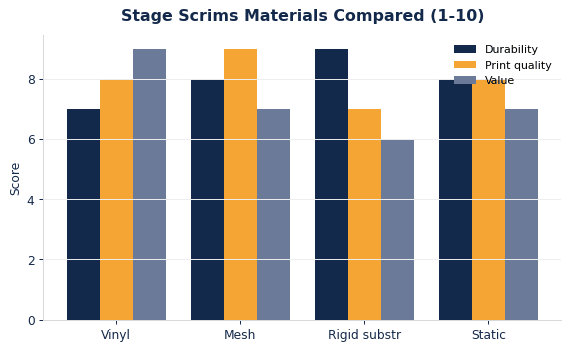
Fabric options: sharkstooth, muslin, and poly voile
Sharkstooth scrim is the classic choice for reveals and logo drops. It’s an open, gauze-like weave, and its opacity depends entirely on which side of the fabric gets more light: front-lit, it reads as a solid printed surface; back-lit, it fades toward transparent so performers or a second set piece behind it become visible. That’s the fabric most bands mean when they ask for a “stage scrim” for their logo backdrop.
Muslin is a tighter, fully opaque cotton weave. It doesn’t do the reveal trick — it’s a solid, paintable surface, closer to a traditional backdrop than a lighting effect. If you just want a clean, opaque printed panel behind the drum riser with no see-through element, muslin is the more predictable material and typically holds ink density better than open-weave scrim.
Poly voile is a lightweight, sheer 100% polyester, built for projection mapping and soft lighting washes rather than printed graphics. It’s the material to ask about if the plan is to throw moving visuals onto the backdrop rather than print a static design onto it.
For most bands and event teams asking about custom stage scrims, sharkstooth is the default — it’s the only one of the three built specifically to change appearance with lighting, which is the effect people are usually chasing.
What custom stage scrims cost by size
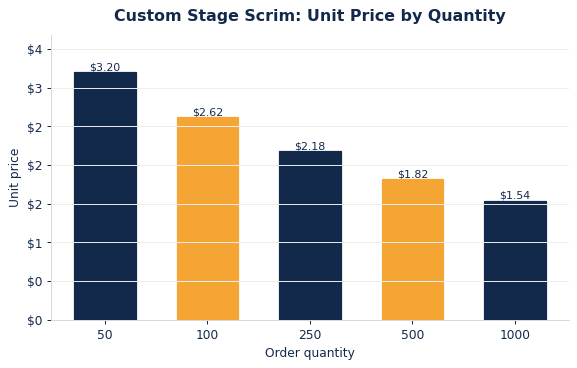
Pricing on scrim and stage backdrop fabric scales close to linearly with square footage once you’re past the smallest sizes. Below is one vendor’s published pricing across five common sizes — it’s a useful benchmark for what a mid-market printer charges, though every shop’s price per square foot will vary with fabric grade, ink coverage, and finishing.
The smallest 5×5 panel runs slightly higher per square foot than the larger sizes, which tracks with what you’d expect: setup and handling costs get spread over less fabric on a small order. Once you’re at 10×10 and above, the rate flattens out. If a quote you receive is dramatically higher than roughly $7–8 per square foot for a comparable size, ask what’s driving the difference — it’s usually finishing, rush production, or a heavier fabric grade.
| Size | Total Price | Price per sq ft |
|---|---|---|
| 5′ x 5′ | $180 | $7.20 |
| 10′ x 10′ | $800 | $8.00 |
| 20′ x 10′ | $1,600 | $8.00 |
| 40′ x 10′ | $3,200 | $8.00 |
| 40′ x 20′ | $6,400 | $8.00 |
Finishing, hardware, and lead times
How the edges get finished matters as much as the fabric choice, because it determines how the scrim actually goes up on your rig. The three standard options are unfinished raw edges (cheapest, meant for teams doing their own sewing or stapling), hem-and-grommet (sewn edges with metal grommets for rope, zip ties, bungee cord, or carabiners), and pole pockets (sewn sleeves at the top and bottom so a truss pole or pipe slides through for a clean, wrinkle-free hang). Grommets are typically spaced every two to three feet along the finished edge — tighter spacing if the scrim will see wind or heavy tension outdoors.
For outdoor stages, bungee cord through grommets is worth the extra step over a fixed rope tie: the elasticity lets the panel move with gusts instead of tearing at the grommet under a sudden load. Indoors on a fixed truss, pole pockets give the cleanest line and are usually the better call for a permanent-feeling backdrop.
On timing, plan on roughly five to seven business days of production once artwork is approved, before shipping. That’s tight if you’re ordering the week of a show — build in the ship time on top of production, and confirm it explicitly with whoever you’re buying from rather than assuming a rush is automatic.
| Metric | Typical Value |
|---|---|
| Average production turnaround | 5 business days |
| Typical grommet spacing | 2–3 ft |
Sizing your scrim to the venue
Size decisions usually come down to the venue you’re actually playing, not the biggest backdrop you can afford. A 6×6 panel is the most common size for small-to-mid-size touring bands — big enough to read from the back of a club, small enough to fold into a road case. For venues holding around 150 people, an 8×8 or 8×10 scrim is the more typical recommendation, giving the logo enough presence without dwarfing the stage.
Above that, you’re into festival and multi-panel territory — 20×10 side-stage panels, or full 40×20 main-stage backdrops built from multiple welded or sewn panels. At that scale, measure the actual truss or frame opening before ordering rather than guessing at a round number; a scrim cut a few inches short of the frame looks worse than a slightly smaller design that fits cleanly.
What to send your printer before you order
Vector artwork or a high-resolution file (300 dpi at final print size, minimum) avoids the soft, pixelated edges that show up fast on a backlit scrim. If your logo has a specific brand color, send the PMS number — color matching on fabric print runs differently than it does on paper or vinyl, and a shop working from a screenshot will guess.
Decide your finishing before you request a quote, not after: grommet spacing and pole pocket diameter change the price and the production steps, so specifying “pole pocket, 2-inch diameter” up front is faster than a round of back-and-forth. And if the venue requires an NFPA 701 certificate, ask for it in writing at order time — it should ship with the scrim, not get chased down separately.
Finally, work backward from your show date. Five to seven business days of production plus shipping means an order placed the week before load-in is cutting it close. Ordering custom stage scrims two to three weeks out gives room for a proof round and a shipping delay without putting the show at risk.
Frequently asked questions
What’s the difference between a stage scrim and a solid backdrop banner?
A scrim is an open-weave fabric that changes appearance with lighting — opaque when lit from the front, transparent when lit from behind, which is what makes reveals possible. A solid vinyl or muslin backdrop banner is opaque from both sides no matter how it’s lit; it’s a static printed image, not a lighting effect.
What size custom stage scrim do I need?
6×6 is the most common size for small-to-mid-size touring bands. For a venue holding roughly 150 people, 8×8 or 8×10 is a more typical recommendation. Larger festival or main-stage setups often run 20×10 side panels or 40×20 multi-panel backdrops — measure your actual truss opening before ordering at that scale.
How long does it take to get a custom stage scrim printed?
Plan on roughly 5–7 business days of production once artwork is approved, plus shipping time on top of that. Order 2–3 weeks before your show date to leave room for a proof round.
Do custom stage scrims need to be fire-rated?
Most theaters, concert halls, and school venues require NFPA 701 flame-retardant certification for any soft goods hung on stage, including scrims. Ask your printer for the certificate at order time — production managers commonly check for it at load-in.
Can the audience actually see through a stage scrim?
With sharkstooth scrim, yes — but only when it’s lit from behind more than from the front. Front-lit, the same panel reads as a solid printed surface. That’s the effect bands use for a walk-on reveal through a lit logo.
Is there a minimum order for a custom scrim?
It varies by supplier — shops selling raw sharkstooth fabric by the yard commonly set a 10-yard minimum, while printers selling finished, sized scrims typically price per panel with no separate yardage minimum. Confirm which pricing model a vendor uses before you request a quote.
The bottom line
The fabric decision drives everything else with custom stage scrims: sharkstooth if you want the front-lit/back-lit reveal, muslin if you want a flat opaque backdrop, voile if the plan is projection. From there, price out your actual size against the roughly $7–8 per square foot benchmark above, lock in finishing (grommet, pole pocket, or bungee-ready) before you request a quote, and give the order 5–7 business days of production plus shipping. Confirm NFPA 701 certification is included if your venue requires it — that’s the detail that trips up otherwise well-planned orders at load-in.